
When design needs to touch human emotion.
In 2014, I started with the world of pixels. Back then, a professional interface was all it took for a business to confidently establish its presence on the Internet. But after more than a decade, especially through my time working at major companies like FPT and VinBigData, I realized that approach had hit its limit. The market shifted, AI emerged, and merely knowing how to paint interfaces became a massive risk for anyone wishing to pursue real value.
The greatest risk today is not an ugly interface, but broken experiences. A polished website is meaningless if it misaligns with actual operational workflows, leaving data trapped, employees exhausted, and customers abandoning the platform due to confusing processes. In an era where AI can generate thousands of interfaces in seconds, the value of a professional no longer lies in aesthetics, but in the capability to solve operational pain points. You yourself must be the one to decide for the AI which interface is correct, which workflow is logical, and defend it before the team.
The explosion of AI is not an end, but a necessary filtration, just as Buddhism teaches us the law of ‘Formation, Stasis, Decay, and Emptiness’, nothing can ever escape this universal cycle. AI can perfectly handle surface-level tasks like color coordination, layout rendering, or pixel optimization, yet it remains completely blind to the context of pain. AI does not know that your warehouse staff must wear gloves while inputting data, or that an accountant is losing their mind opening multiple browser tabs just to reconcile a single order. AI sees the screen, but we see the human beings and feel the fractures within their daily workflows.
Those exact limitations of technology become our golden opportunity. When machines free our hands from repetitive tasks, that is when we must use our brains to do what algorithms cannot: field empathy, solution architecture, and a commitment to the product’s success for both customers and users.
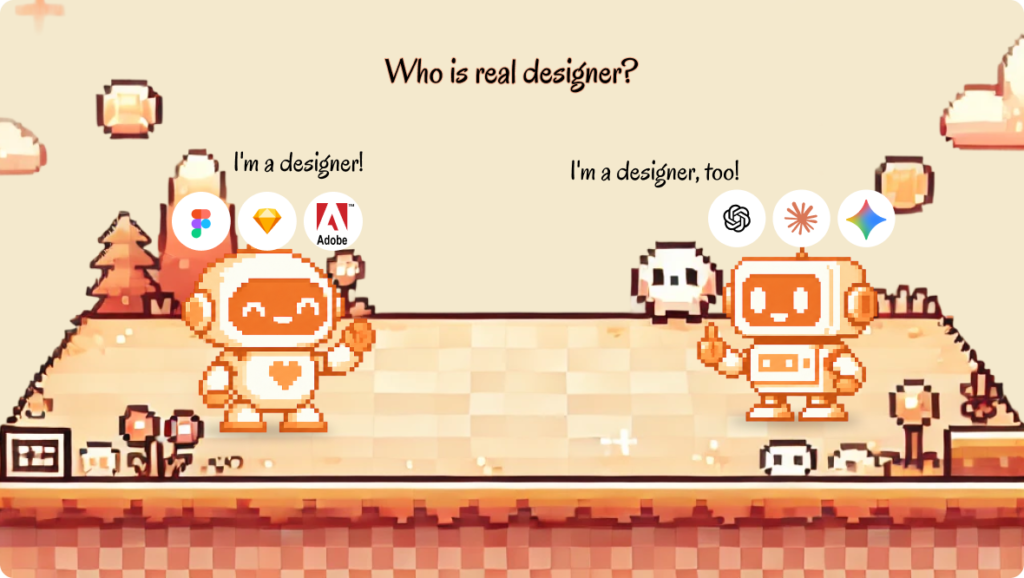
When AI commoditizes the hands of the designer.
That is why the transition from Web Design to UI/UX and ultimately to Experience Design is not a choice, but an urgent demand for survival. I no longer stand in the position of an interface designer. The market demands us to be the architects of experiences.
- Web and app design are the starting steps to create a presence.
- UI/UX is the tool to optimize interaction on the screen.
- Experience Design is the ultimate destination — where a User-Centered Design mindset is employed to look through business problems and empathy is used to connect every touchpoint into a seamless workflow.
At EKD Lab, I share tools, design mindsets, and core principles so we can collectively understand: as AI and technology change by the day, the only thing keeping us standing is the capacity to design systems with a soul, with empathy, and that truly solve the efficiency puzzle for humans.